TPMDC
« Sebelius Update | Home | Do Not Read This Story While Drinking Liquids ... »

Dems: Keeping Wall Street Profits High is 'Collateral Benefit'

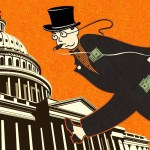
In Rolling Stone's new interview with Speaker Nancy Pelosi (D-CA), she embraces the notion of "collateral benefit" for major financial corporations that are benefiting from the $700 billion TARP bailout.

The "collateral benefit" idea was first elucidated by Barney Frank (D-MA), chairman of the House Financial Services Committee. As Frank explained it to PBS last month, the inextricable intertwining of ordinary Americans' livelihood with Wall Street's livelihood makes it impossible not to help big banks while saving the U.S. economy:

[Y]ou can't help the whole system without some incidental benefits to people that want help. It is the reverse of something terrible that we have learned to live with, collateral damage. That's in a war. ... We have the reverse of this. We have something called collateral benefit. That is, you want to get the credit system functioning again, but you can't create a whole new one from scratch. You have to work with what you have got. So one effect of helping the credit system is you are going to provide some collateral benefit, literally to people you would rather yell at.

Frank's "collateral benefit" theory makes no attempt to get at why more and more Americans have entrusted their financial future to the market over the past two decades, thereby making it impossible to save the economy without keeping Wall Street afloat.

But conservatives know the source of this cultural shift -- themselves. Right-wing strategists have long attempted to solidify a long-term Republican majority through promoting stock ownership. Listen to conservative godfather Grover Norquist, telling Frontline in 2005:

The left understands that America is drifting away from where they want to be. ... It's the last 25 years. 1980, only 20 percent of Americans owned stock. Today over 60 percent of Americans do through 401(k)s and IRAs. And those people have been drifting toward the Republicans and the conservatives ... ever since.

Ken Mehlman, the former Republican party chairman, told Frontline that year that the GOP wanted to broaden its appeal to minorities by encouraging stock purchases:

The tax relief, which says to an increasing majority of Americans: Own stock and investments, we're not going to double-tax you on that; that's wrong.

Now, it's debatable whether investing in the market is more likely to make you a Republican, as Slate memorably observed five years ago. But when Frank and Pelosi talk about the bailout offering "collateral benefit" to major banks while primarily helping the everyday taxpayer, remember the dogged GOP campaign to make us a nation of stock-owners. It played a crucial role in ensuring that TARP looks the way it does and was implemented the way it was.

Ah, one more thing: Here's what Pelosi told Rolling Stone, when its interviewer asked about populist anger at bailed-out banks.

Your question is best answered by quoting Barney Frank. He says, 'We talk a lot about collateral damage, but sometimes there's collateral benefit, whereby doing the right thing for the American people and the economy enables some people to benefit who we don't want to benefit.

19 Comments

| Leave a comment
user-pic

My perception of what the Republicans did is that they turned our entire economy, with significant help from Sam Walton, into what amounts to a tourist economy. It's based on nothing more than retail sales, whether stock or microwaves and sets of stainless flatware - all made elsewhere, usually China. Or for that matter, bundles of mortgage debt.

I'm sure that's simplistic, but I didn't come up with it on my own, even at that. Frontline did a piece on Walmart that was just astounding, about 3 years ago I think. It was explained how Walmart had managed to completely reverse the usual manufacturer to retail equation in this country and put it all on retail manufactured elsewhere.

user-pic

Elana, I think you've twisted Frank's words beyond recognition in reaching for a conclusion that's not there. Where does he equate the "collateral benefit" with stock ownership? Everyone's welfare depends on a functioning credit market and solvent banks, either directly, since we all have home mortgages, car loans, credit cards, etc., or indirectly, since our employers (and hence, our jobs) depend on credit to keep their business functioning.

This has nothing to do with how many people own stock. A capitalist system requires the movement of capital, and the credit market is one of the prime conduits. If the banks go down the drain, the economy goes with it.

user-pic

I don't object - much - to the idea that 'doing the right thing for the American people and the economy enables some people to benefit who we don't want to benefit'. It's that the whole plan seems to be designed to benefit Wall Street first, and the other 98 percent of us only incidentally, and that's bass-ackwards.

If the rest of us don't have money to invest - whether it's buying directly, second-hand through 401Ks and IRAs, or third-hand through buying food and goods - then Wall Street is going to take a major hit. This doesn't seem to be registering on those making decisions.

user-pic


I don't object - much - to the idea that 'doing the right thing for the American people and the economy enables some people to benefit who we don't want to benefit'.

I don't object at all inasmuch as it is common sense.

And I'm seeing the effects of this meltdown and I want to see the stimulus work and I don't care if some people who don't deserve it nevertheless profit from it.

user-pic

Frank:

[Y]ou can't help the whole system without some incidental benefits to people that want help. It is the reverse of something terrible that we have learned to live with, collateral damage. That's in a war. ... We have the reverse of this. We have something called collateral benefit. That is, you want to get the credit system functioning again, but you can't create a whole new one from scratch. You have to work with what you have got. So one effect of helping the credit system is you are going to provide some collateral benefit, literally to people you would rather yell at.

Thank you Ronald Reagan.

user-pic

Oops. Rather,

...you want to get the credit system functioning again, but you can't create a whole new one from scratch. You have to work with what you have got.
user-pic

So what halcyon, bygone era to you have in mind when it was possible to save the economy in a serious economic downturn while allowing Wall Street to fail?

I noted some time ago that we can get the economy back on its feet or we can have retributional justice against the people and institutions in the world of finance that got us into this mess, but we can't have both. Getting the credit markets functioning normally again is essentially synonymous with getting the economy functioning normally again. However much we might wish it were otherwise, we can't do that without benefitting the greedy sobs who created this trainwreck.

Oh well, guess we'll just have to keep taking our anger out out on their enablers in the Republican Party.

user-pic

So what halcyon, bygone era to you have in mind when it was possible to save the economy in a serious economic downturn while allowing Wall Street to fail?

Well, since Poulson pulled the trigger on the meltdown by letting Lehman Bros. go under - that started all this - then I'd say you are sane.

And I appreciate every tiny little bit of sanity. I think it is incumbent on progressives to at least look sane and sound sane. It makes such a nice contrast to the GOP.

user-pic

I've noticed that the lawyers around here have a different take than most people on the meltdown.
I suspect once you've obtained enough understanding of Articles 2, 3 and 9 of the UCC to pass a state bar exam, its kind of hard not to. A lot of people here are busy boiling up some tar and ripping open pillows. The lawyers are too busy worrying about how companies are going to make payroll and goods are going to get from the manufacturer's loading dock to the retailer's without credit.

user-pic

Frontlines' "Inside the Meltdown" indicates there was some kind of bad blood between Paulson and the head of Lehman Bros. His decision to let them fail appears to have had some personal motivations.

Like so much else in the Bush years, this deserves some light shown on it.

user-pic

God that's terrible messaging. Oh hey, we're going to take your tax money to save the country, and by the way the rich bankers who fucked everything up are going to get some "Collateral Benefit"

It really is like the opposite of collateral damage, rather then having your legs blown off through no fault of your own, you get billions of dollars even thought he problems really are your fault!.

user-pic

If you have a plan on how to get the unemployment level to 4% and simultaneously punish the evildoers on Wall Street, I'll be glad to hear you out. Until then, its looking like "Jobs. Retribution. Pick one."

user-pic

I prefer: Jobs. Pause. Retribution. They don't have to be simultaneous occurrences.

A few or more years down the road, these captains and wizards should expect two or more new tax brackets at the top-most income levels. At the same time, we can push countries to do as the Swiss are now apparently doing--open up the records. And if these captains and wizards want to leave, well, don't let the door hit their collective a$$es as they exit.

user-pic

Now that's change I can believe in.

Personally, I'd like to see a hefty "excess compensation" tax that kicks in on executive compensation over and above regular salary that is determined based upon contingent events not directly attributable to the efforts of the taxpayer. A tax on bonuses, that is to say, but not on sales commissions.

user-pic

I was about to say, the way to claw back some of the "collateral benefit" is through the tax system. Your idea seems like a good start.

user-pic

Of course, it goes without saying that I would want this tax to only kick in at a level well above any bonus I could ever expect to get. But, trust me, that leaves a lot of room.

user-pic

What we need is restitution, such as the IRS is seeking from the Swiss bank. By happy accident, it will bring a degree of retribution, since money is all these folks value.

user-pic

Now that I've lost a lot of confidence in Barney Frank, I have only one entity in Congress that I trust; Bernie Sanders.

user-pic

Elena - "Frank's "collateral benefit" theory makes no attempt to get at why more and more Americans have entrusted their financial future to the market over the past two decades, thereby making it impossible to save the economy without keeping Wall Street afloat."

Ick. You're looking backwards, not learning from history. Also, where besides in capital investments would you have people put their money, into houses with huge interest payments?? Finally, "saving the economy" is a short-term means having to do with banks and similar investors, not Wall Street overall in the end. Other than institutions holding troubled assets, stock prices are down because people expect harder times ahead. This includes Detroit which is hard hit because so many people stopped buying new cars last year that sales volume was down about 1/3 overall.

Given that trillions were taken out of home equity in the private sector, and added to government debt, to prop up a weak economy under Bush, it's not the fault of Wall St. that stocks overall are down.

Leave a comment

Advertisement
Please disable your adblocker!
Ads are how we pay the bills!

Subscribe

Josh
Marshall

Bio

Elana
Schor

Bio

Matt
Cooper

Bio

Eric
Kleefeld

Bio


Latest Videos


Advertise Liberally
Share
Close Social Web Email

"To" Email Address

Your Name

Your Email Address